Fix
How to Fix a Macrame Plant Hanger: Tilting, Sagging, Too Long
Published
Short answer
A tilting pot almost always means the basket knots are at different heights or the arms are unequal: measure each knot from the ring and retie the odd one level. A pot that slips through needs the joining knots moved up, and one that will not go in needs them moved down. A hanger that is too long is shortened by retying the basket higher up the arms.
Most plant hanger faults sit in the basket, the net of joining knots under the arms, and can be fixed without cutting new cord. Square knots and overhand knots can be picked open with a blunt needle or the tip of a crochet hook, so a row can be moved up or down as often as needed until the tassel is trimmed. Check the hanger with the pot in it and the plant watered, because a hanger changes shape under load. What it can carry is not decided by the knots: the hook and its anchor are the limit.
What is wrong with the hanger: symptoms and fixes
Hang the hanger with the pot in it and look from two sides. Match what you see to the first column. The causes are listed with the most common first.
| What you see | Likely cause | What to do |
|---|---|---|
| Pot tilts to one side | Basket knots in one row tied at different heights | Measure each knot from the ring, untie the odd one and retie it level |
| One arm slack while the others are tight | Arms of unequal length | Bring every joining knot to the same distance from the ring |
| Pot slips through or sinks deep in the net | Basket too wide: gaps between rows too long for the pot | Move the joining knots up, or add a row |
| Pot will not go in, or perches on top | Basket too narrow: gaps too short | Move the joining knots down |
| Plant hangs too low | Hanger too long for the spot | Raise the hanging point, or retie the basket higher and trim the tassel |
| Hanger longer than when it was hung | Knots settling and soft cord giving under load | Let it settle with the pot in, then level the basket again |
| Wrap at the top or bottom sliding | Gathering knot tied slack | Retie it with firm wraps |
Pot tilts: basket knots at different heights
The pot rests on the joining knots, so it leans toward the lowest one. Take the pot out and let the hanger hang. For each knot in the first row, measure along the cord from the bottom of the ring to the knot. Untie the knots that are off and retie them at the same distance as the rest, then repeat for the second row.
Do not judge by counting the knots in the arms, or by eye from the knot above. Ten tight square knots are shorter than ten loose ones, so two arms with the same count can end at different heights. Always measure from one fixed point: the ring or the top gathering knot.
Arms of unequal length
If one arm goes slack when the pot is in, that arm is longer than the others between the ring and its first basket knot. The usual causes are cords folded off their middle at the start, a top wrap that let some cords slide, or arms knotted with different tension. Level basket knots cure it: once every joining knot is the same distance from the ring, the arms carry the pot evenly even if their knotted sections differ a little.
On a hanger still in progress, fix it before the basket. Hold all the arms together, pull them straight and compare where the last knot of each arm ends. Add a knot to the short arms or untie one on the long arm until they match. An arm that twists instead of lying flat is a different fault: see why is my macrame twisting.
Basket too wide or too narrow for the pot
The opening between two arms is set by the length of unknotted cord above the joining knot. Tie the joining knots lower and the opening gets larger. Tie them higher and it gets smaller. For a pot that slips through, shorten the gaps or add one more row of joining knots below the last. For a pot that will not go in, lengthen the first gap.
As a starting figure, gaps of about a third to a half of the pot's diameter suit most pots: 2 to 3 in for a 6 in pot, 3 to 4 in for an 8 in pot. The bottom knot belongs under the center of the base, roughly the radius of the base below the last row. The plant hanger size guide has typical figures for 4 to 12 in pots. A wide pot in a hanger with 3 arms may keep slipping, because the openings between 3 arms are large: the cure is a hanger with 4 arms.
Hanger too long or hanging too low
First measure with the pot in. A hanger is shorter loaded than empty, because the basket opens around the pot: one published pattern measures 36 in empty and about 28 in with a 9 in pot in it. If the plant is still too low, there are three ways to gain height. On arms knotted all the way down, the second one also means untying arm knots from the bottom to make room.
- Raise the hanging point: a shorter hook, or no chain or S hook between the ring and the ceiling hook. Nothing on the hanger changes.
- Retie the basket higher. Cut off the bottom wrap, cutting only the wrapping cord, and untie the joining rows, move every row up the arms by the amount you need, close with a new gathering knot and trim the longer tassel.
- Take up a few inches at the top with one overhand knot tied in the whole bundle just under the ring. It is quick, and bulky.
Note.Do not shorten a hanger by folding the top over and binding the fold with a wrap. The folded end would be held by the wrap alone. Keep the load running through whole cords from the ring to the pot.
Does macrame cord stretch?
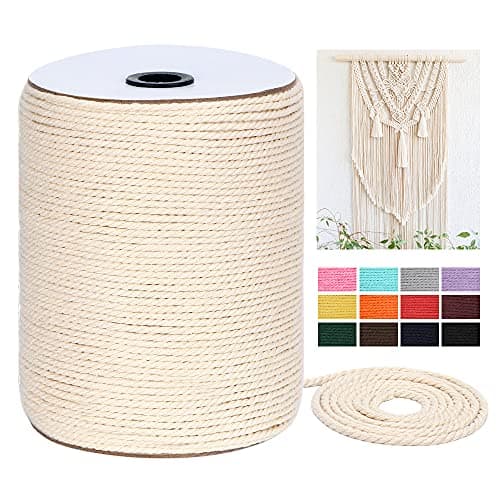
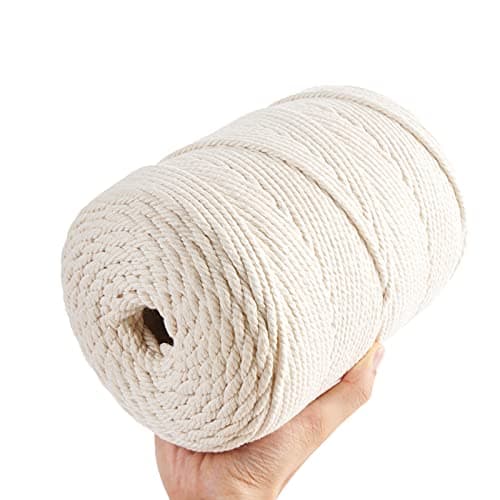
Cotton cord gives a little under load, and every knot in a new hanger tightens the first time it carries a pot. Together that lets a hanger settle slightly lower than it measured on the table. No checked source puts a number on it, so none is given here. Soft single strand cord gives the most. 3 ply cord is firmer and holds its shape, and braided cord is firm as well, which is why those two are the usual choice for hangers that carry heavy pots.
Keep cotton dry: it absorbs moisture and can mildew, and a soaked pot is heavier. Water the plant out of the hanger, or let the pot drain before it goes back. Outdoors, polypropylene or polyester cord resists water. The constructions are compared in macrame cord types.
How to prevent a crooked plant hanger
Nearly all of these faults come from measuring by eye or from skipping the trial fit. Five habits prevent them on the next hanger.
- Fold every cord exactly at its middle before mounting, and pull the top gathering knot tight so no cord can slide.
- Measure every knot from the ring with the hanger hanging, and mark the spot with a strip of tape before tying.
- Tie one full row around the hanger before starting the next, then look at the row from the side.
- Set the pot in the basket before the bottom gathering knot and again before trimming the tassel. Trimming is the one step that cannot be undone.
- Weigh the pot watered and check it against the rating printed on the hook package. Fix the hook into solid structure such as a joist: see how to hang a plant hanger.
Quick answers
Short answers on fixing a hanger. No weight figures are given: the rating of the hook and anchor is the stated limit for any hanger.
- Does macrame cord stretch? Cotton gives a little and new knots tighten under load, so a hanger settles slightly. 3 ply and braided cord hold their shape better than single strand.
- How do you fix a macrame plant hanger that tilts? Measure each basket knot from the ring, untie the ones that are off and retie them at the same height.
- How do you shorten a macrame plant hanger? Raise the hook, or untie the basket, retie it higher up the arms and trim the tassel.
- Why does the pot slip through my plant hanger? The gaps between basket rows are too long for the pot. Move the joining knots up or add a row.