Explainer
The Macrame Knots You Need for a Plant Hanger
Published
Short answer
A basic macrame plant hanger needs five knots: the larks head to mount cords on the ring, the gathering knot to bundle them at the top and bottom, the square knot and the half knot spiral for the arms, and the overhand knot for simple joins and stops. The basket is made of the same square or overhand knots, tied across neighboring arms.
A plant hanger looks complicated because it is long, not because it uses many knots. Most free patterns repeat the same few knots in the same order from top to bottom: a start on a ring or loop, a wrap, knotted arms, a basket and an end knot. Knowing which knot sits where lets you read any pattern, swap a spiral for a square knot section, or work out what went wrong. This page names the knots and their places. How to tie the wrap, how much cord to cut and how to size the basket each have their own page, linked below.
Macrame plant hanger knots in order, top to bottom
Read the table as a map of the hanger from the hook down. The same knot can appear twice: the gathering knot opens and closes the hanger, and the square knot builds both the arms and the basket.
| Where on the hanger | Knot | Cords it uses | Its job |
|---|---|---|---|
| 1. Top, on the ring | Larks head, or cords folded through the ring | 6 or 8 cords, each folded at its middle | Mounts the cords on a 2 in (50 mm) ring |
| 2. Just under the ring | Gathering knot (wrap knot) | 1 separate wrapping cord | Binds all 12 or 16 strands into one neck |
| 3. Arms | Square knot | 4 strands: 2 working, 2 filler | Flat, firm sections of each arm |
| 4. Arms | Half knot spiral | The same 4 strands | Twisting sections between the flat ones |
| 5. Basket | Alternating square knot or overhand knot | 2 strands from one arm, 2 from the next | Joins neighboring arms into a net for the pot |
| 6. Bottom | Gathering knot again | A second wrapping cord | Closes the net under the pot, tassel below |
The start: ring, larks head or loop knot
Most hangers start on a wood or welded metal ring of about 2 in (50 mm). The cords are either folded through the ring at their middle and wrapped just below it, or mounted one by one with a larks head knot, which folds the cord over the ring and passes both ends through its own loop. Either way, 6 folded cords give 12 strands and 8 give 16.
The loop knot that some patterns mention is a start with no ring. The middle of the bundle is wrapped or knotted over about 7 in (180 mm), folded into a loop and closed with a gathering knot. Four ways to build it are in plant hanger without a ring.
The gathering knot: top and bottom
The gathering knot is a separate cord of 20 to 24 in, wrapped 6 to 10 times around the whole bundle and locked by a loop hidden under the wraps. A hanger uses two. One sits under the ring. The other sits under the middle of the pot's base, and the cords below it are trimmed level as a tassel, 5 to 8 in long in the patterns checked. Thick cord and wide bundles need a longer wrapping cord, up to about 40 in. The six steps and the usual failures are in how to tie a gathering knot.
Macrame plant hanger square knot: the arms
Each arm is 4 strands. The two in the middle are filler cords and hang straight. The two on the outside are working cords. A square knot is two half knots tied in opposite directions around the fillers. Tied one under another, square knots make a flat, firm strip. With 12 strands a hanger has 3 arms, with 16 strands it has 4.
The working cords are used up several times faster than the fillers: roughly 4 to 6 times the knotted length against 1.5 to 2 times. That matters on a hanger whose arms are knotted all the way down. Open arms with a few short knotted sections use much less, which is why hanger patterns cut shorter cords than wall hanging patterns of the same length. Cut lengths are in how much cord for a plant hanger.
The spiral: one half knot repeated
Tie only the first half of the square knot, always starting from the same side, and the strip twists into a spiral. Let it turn as it grows. One published 4 mm pattern ties 20 half knots for a spiral about 4 in long, between two 2 in sections of square knots. If an arm that should be flat is twisting, the same half was repeated by mistake: see why is my macrame twisting.
Basket knots: joining the arms under the pot
Below the arms, each group of 4 strands splits in two. Two strands from one arm meet two from the next arm and are tied together some inches lower, with a square knot or, on simple hangers, an overhand knot. Going all the way around makes one row. A second row, offset again, closes the net further, and a pattern may add a third for a tall pot.
The distance between rows is what fits the hanger to the pot: about a third to a half of the pot's diameter, which is 2 to 3.5 in in published patterns for 5 to 7 in pots. Figures by pot size are in the plant hanger size guide.
Note.Tie each row all the way around before starting the next, and measure every joining knot from the ring. Knots at different heights are the usual reason a pot tilts.
What do I need to make a macrame plant hanger?
The supplies list is short, and most of it is already in the house. Cord is the only item that needs working out before you start.
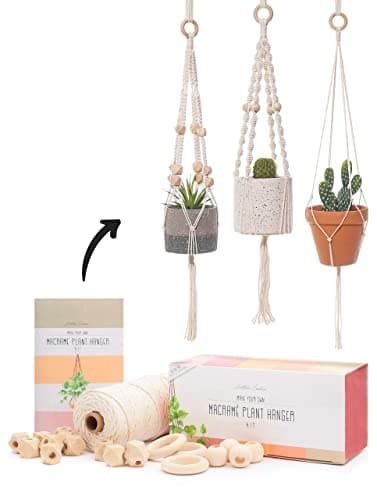
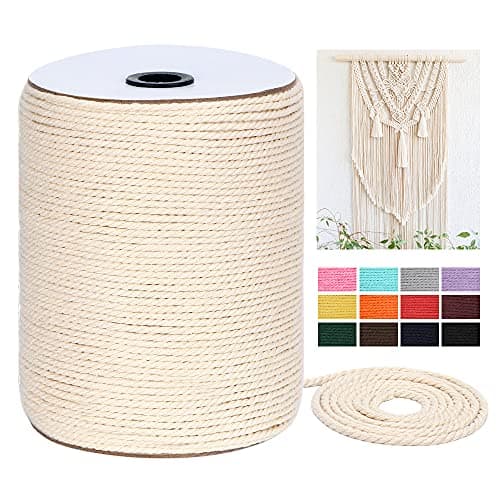
- Cord: 4 mm cotton is the usual plant hanger size, 3 ply or braided for a firmer hanger. The cord calculator puts a 36 in hanger with 8 cords at about 46 yards at the long end of its range.
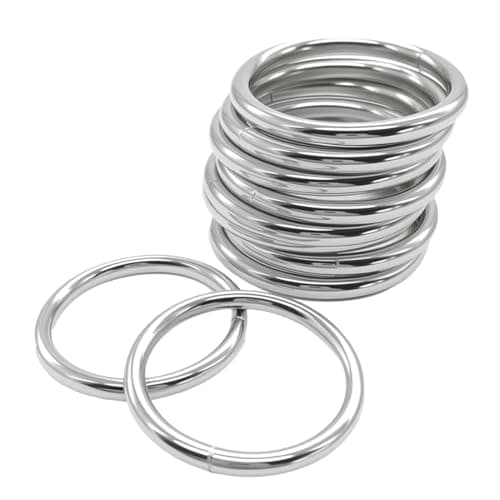
- A ring: wood or welded metal, about 2 in (50 mm). Not needed for a loop start.
- Two wrapping cords of 20 to 24 in for the gathering knots, cut from the same cord.
- Sharp scissors and a tape measure. Tape on the cord ends keeps them from fraying while you work.
- Somewhere to hang the work at a comfortable height while knotting: a hook, a door handle or a clothes rail.
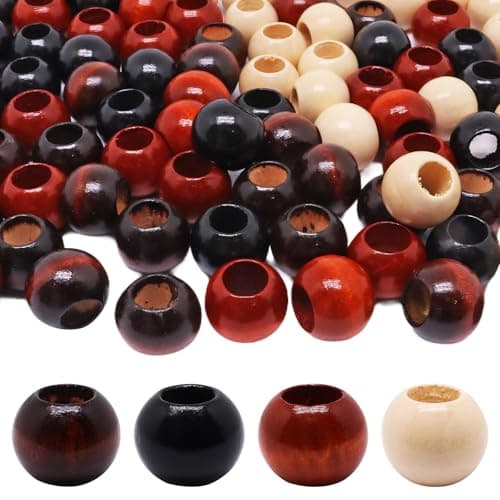
- Optional beads with a hole 1 to 2 mm wider than the cord: 5 to 6 mm holes for 4 mm cord.
- A ceiling hook with its rating printed on the package, fixed into solid structure such as a joist.
Quick answers
Short answers on knots and supplies for a first plant hanger. Lengths and sizes are typical figures from published patterns, given as ranges.
- Which macrame knots do you need for a plant hanger? Five: larks head, gathering knot, square knot, half knot spiral and overhand knot. Simple hangers get by with fewer.
- How do you tie a macrame plant hanger from start to finish? Mount 6 or 8 folded cords on a ring, wrap them, knot 3 or 4 arms, join neighboring arms in two rows for the basket and close with a second gathering knot.
- What is the loop knot on a macrame plant hanger? A top loop made from the cords themselves instead of a ring: about 7 in of the bundle is wrapped, folded over and closed with a gathering knot.
- What supplies do I need for a macrame plant hanger? 4 mm cord, a 2 in ring, scissors, a tape measure and a hook to work from. Beads are optional.